
What the Yellow Book Adds — and Why It's Different
Why Adjustment Support Matters More Than Ever
By Timothy J. Hansen, RPRA, MNAA
Article 3 of 9 | The Adjustment Series | Blue Ridge Valuation Services LLC
If you do appraisal work for federal agencies, or if your work ends up in eminent domain proceedings involving federal funding, you have probably encountered the Uniform Appraisal Standards for Federal Land Acquisitions — universally known as the Yellow Book. But even experienced appraisers who work regularly in this space are sometimes unclear about what the Yellow Book actually requires for adjustments, and how those requirements differ from USPAP.
The short answer: the Yellow Book builds on USPAP; it does not replace it. But what it adds is significant, and understanding those additions is essential for anyone who works in federal acquisition, eminent domain, or related contexts.
What the Yellow Book Is and Why It Exists
The Yellow Book is published by the Interagency Land Acquisition Conference and governs appraisals conducted for federal land acquisitions and many federally assisted projects. It is the controlling standard for a wide range of condemnation and public acquisition work, including acquisitions by the Department of the Interior, the Army Corps of Engineers, the Federal Highway Administration, and other federal agencies.
The first edition of the Yellow Book was published in 1971 on the heels of the passage of the Uniform Relocation Assistance and Real Property Acquisition Act of 1970 which sought to create uniformity across government in how landowners whose land was taken for public purposes were treated during the acquisition process. The purpose of the first Yellow Book was to help appraisers understand how to implement the new requirements in the Uniform Act. It is worth noting that the Yellow Book precedes USPAP by fifteen years.
Unlike USPAP, which is broadly applicable across all appraisal disciplines and assignment types, the Yellow Book is specifically designed for the just compensation context. That focus shapes everything about how it addresses methodology, including adjustments. The Yellow Book is not trying to define best practices for appraisal generally. It is trying to define what is required to produce a credible, defensible just compensation estimate that will withstand adversarial scrutiny.
That distinction is important. It means that many of the Yellow Book's requirements are calibrated for a higher-stakes, more adversarial environment than most appraisal work. The bar is set where it is because that is where it needs to be given the context.
Where the Yellow Book Builds on USPAP
Emphasis on Market-Derived Adjustments
USPAP requires that adjustments be credible and market-supported. The Yellow Book agrees and then goes further by placing a particularly strong emphasis on deriving adjustments directly from market data. While USPAP allows qualitative adjustments supported by reasoned analysis, the Yellow Book pushes appraisers toward quantitative support wherever the market provides it.
This does not mean that qualitative adjustments are never appropriate in Yellow Book work. They are, in situations where the market data is insufficient to support quantification. But the Yellow Book's expectation is that appraisers will exhaust the available quantitative evidence before relying on qualitative conclusions. Vague or impressionistic adjustments that could have been grounded in data but were not can be harder to defend in federal acquisition work than in other contexts. As a reviewer of Yellow Book appraisals, I often prefer a well-reasoned qualitative adjustment over a quantitative adjustment with little support. There is also a practice seen too often of assigning a percentage value to a qualitative adjustment for the purpose of calculation. I have seen appraisers go through a complicated process of defining a “+” or “-” qualitative adjustment as each “=” or “-” being a certain percentage. As an example, if the comparable is far superior to the subject property, the appraiser may give it an adjustment of “+++” and then go on to say that each “+” corresponds to a 10% difference. If the percentage is applied to the subject property, this is a quantitative adjustment without support no matter how it is labeled.
Non-Appraiser Audience
One of the most practically significant requirements the Yellow Book adds is the expectation that the appraisal report be written for a sophisticated but non-appraiser audience. Judges, attorneys, agency reviewers, and property owners will read these reports. The adjustment methodology needs to be explained clearly enough that a reader without appraisal training can follow the logic.
This requirement has real implications for how adjustment support is documented. Jargon-heavy explanations that appraisers understand intuitively may be opaque to a judge or a property owner's attorney. The test is not whether your report makes sense to a fellow appraiser. It is whether it makes sense to an intelligent, motivated reader who is not an appraiser.
In practice, this means that adjustment documentation in Yellow Book work needs to be more explicit about the logical steps between market evidence and adjustment conclusion. Explaining not just what the data showed, but how you interpreted it and why that interpretation supports a specific adjustment, is part of the standard.
Consistency and Internal Coherence
The Yellow Book places particular importance on the internal consistency of the adjustment framework. Adjustments that are applied differently across comparables without explanation draw sharp scrutiny. If a feature warrants a significant adjustment for one comparable and a minor adjustment for another, the report needs to explain why and not leave the reader to wonder.
This requirement for internal coherence goes beyond what USPAP explicitly mandates, though a credibility argument could be made under USPAP as well. In Yellow Book work, inconsistency is not just a credibility problem. It is a target for opposing expert criticism that can undermine the entire appraisal.
The Yellow Book Practitioner Perspective
As a named contributor to the 6th Edition of the Yellow Book, I can offer some perspective on the intent behind its requirements. The standards are written the way they are because federal land acquisition involves real property owners who are compelled to sell land that has often been in their families for generations and under the 5th Amendment to the U.S. Constitution, they are entitled to just compensation determined by a rigorous, transparent, and defensible process.
The Yellow Book's demands on adjustment methodology are not bureaucratic formality. They reflect a genuine commitment to a process that property owners, their attorneys, and the courts can scrutinize and trust. When an appraiser cuts corners on adjustment support in a Yellow Book assignment, the damage goes beyond a single report. It affects the property owner's ability to evaluate whether the compensation offered is fair and harms public trust in the appraisal profession.
The Yellow Book's demands on methodology are not arbitrary. They reflect the stakes involved when government compels the sale of private property. Just compensation requires just methodology.
A Different Stakes Environment
One of the most important practical differences between standard USPAP work and Yellow Book work is the litigation environment. In federal acquisition and condemnation proceedings, your report and your methodology will often be tested in court. Opposing experts will examine your adjustments. Attorneys will probe the support behind each line item. Your deposition may be taken. You may testify at trial.
This is not hypothetical. It is the normal operating environment for Yellow Book appraisers. And it means that every methodological decision you make should be made with the awareness that it may need to be explained and defended under cross-examination.
That awareness should not be paralyzing. It should be clarifying. When you ask yourself whether your adjustment support is adequate, the test is not whether it satisfies you, but whether it will satisfy a skeptical opposing expert and, ultimately, a judge. That is a higher bar for sure, but it is a clear one.
Implications for USPAP Practice
Even if you do not work in federal acquisition or eminent domain, the Yellow Book's approach to adjustment methodology offers useful guidance. Appraisers who develop strong adjustment habits for Yellow Book work including quantitative support grounded in market data, clear documentation for a non-appraiser audience, internally consistent adjustment frameworks will produce better USPAP work as well. In an assignment where the Yellow Book is applicable, the two standards are linked together through the USPAP Scope of Work Rule and the Competency Rule. The USPAP Scope of Work Rule requires that appraisers to identify assignment conditions as a part of the scope of work decision. Laws and regulations are specifically named as assignment conditions and laws include “court-made law” which is what is included in Section 4 of the Yellow Book. Because of the referential nature of these requirements, there is no such thing as a “USPAP only” appraisal when it comes to government acquisitions.
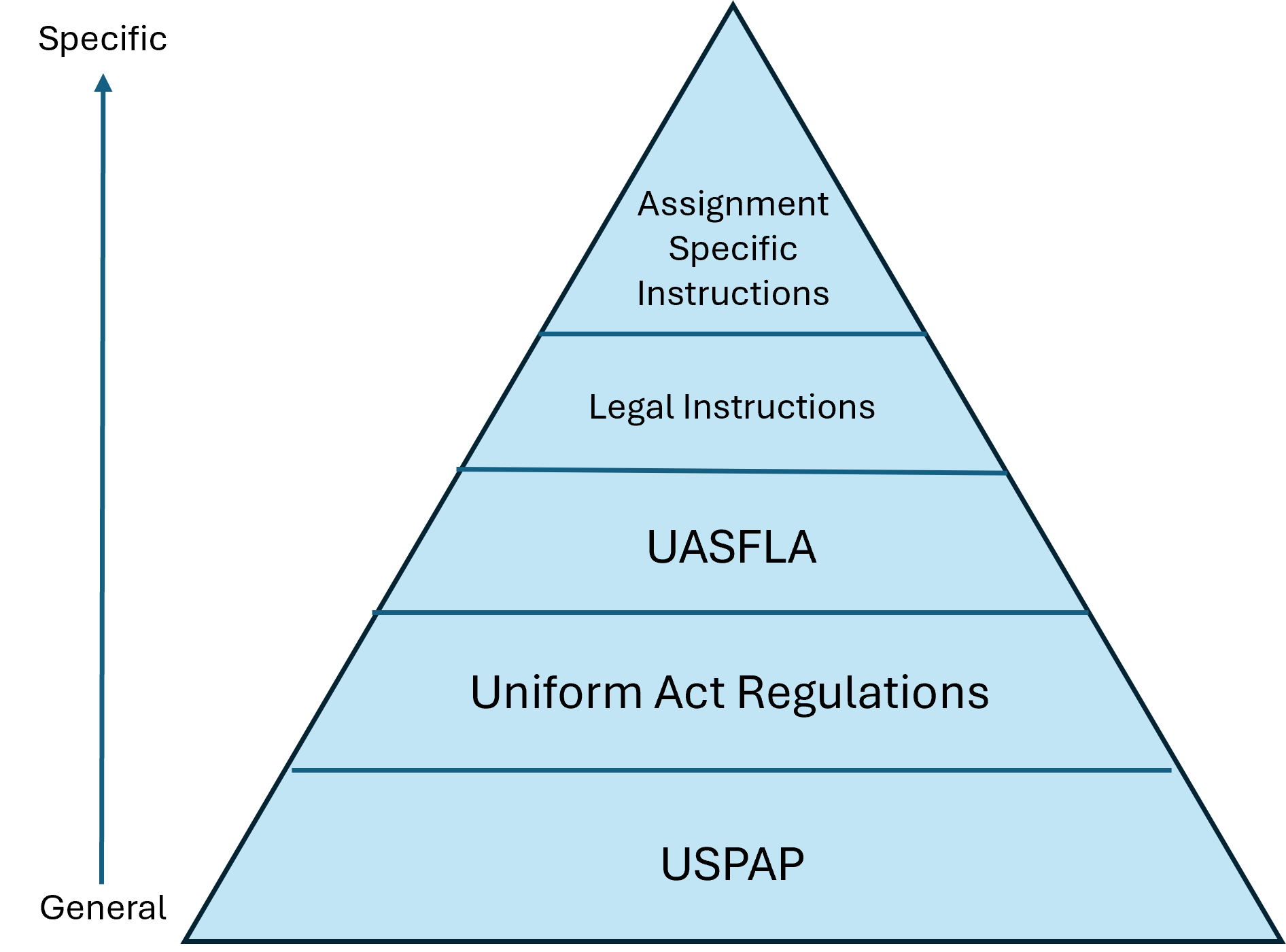
USPAP lays the foundation for appraisal practice, and each subsequent assignment condition creates specificity for the appraiser.
The discipline carries over because the underlying goal is the same: a credible, defensible value conclusion that reflects what the market shows. The Yellow Book simply demands more rigor in execution and more clarity in communication than the minimum USPAP standard requires.
The Bottom Line
The Yellow Book is a higher-resolution version of the same underlying standard that USPAP establishes. The core principles of market support, credibility, transparency are identical. What the Yellow Book adds is a clearer expectation about how those principles are applied in a high-stakes, adversarial context.
For appraisers who work in federal acquisition and eminent domain, understanding the Yellow Book's specific requirements is not optional. For those who do not, the Yellow Book's approach to adjustment methodology still offers a useful model for what rigorous, defensible work looks like.
Working on a complex assignment or adjustment methodology question? Blue Ridge Valuation Services LLC provides appraisal consulting, litigation support, and expert witness services. Visit
blueridgevaluationservices.com to get expert valuation assistance today.
Next in the series: Article 4 — Qualitative vs. Quantitative Adjustments: Different Tools — Not Different Standards
